

Companies are pouring billions into AI to drive efficiency. Meanwhile, their most valuable customers are quietly walking away. The reason? They forgot to factor in the human equation.
As a lifelong consumer strategist and advocate helping businesses understand changing consumer needs and find ways to meet them, I’m as surprised as anyone to find myself fully immersed in the world of rapidly changing workforce dynamics. I resisted this for years, but now I believe more strongly than ever that an organization’s workforce - its people - holds the key to competitive advantage across the consumer landscape in the age of AI.
I understand that on the surface this seems counterintuitive. AI is pushing organizations toward more tech and fewer people. At the same time, a perfect storm is emerging that gives forward-looking companies a narrow window to outpace competitors by elevating their workforce as a central pillar of their customer strategy.
Here’s why this matters now.
A Sea of Sameness
Consumers are drowning in look-alike products, identical experiences, and brands that all sound the same. Brand differentiation has collapsed to a two-decade low according to WPP, with 75% of top brands losing distinctiveness in the past 10 years. My research shows that Gen Z especially gravitates toward what feels distinctive, purpose-driven, and real. The companies that break the pattern with clarity, courage, and originality are the ones that stand out and win.
The AI Adoption Race
Meanwhile, the race is on. The pressure is real. Organizations everywhere are scrambling to integrate AI and Wall Street is watching. A company’s worth is now shaped, in no small part, by how boldly it invests in systems that streamline work, unlock efficiency, and signal it’s ready for what’s next. The race ahead is largely focused on improving back of house efficiencies, which can improve front of house employee ability to serve customers. But the race to solutions that miss the human element will sacrifice human connection and exacerbate the rise of sameness.
A Craving for Authentic Human Connection
At the same time, Gen Z is demanding what many others have quietly wanted for years: real transparency, real humanity, real connection. In the workplace and in the marketplace, people are tired of transactional experiences. They want leaders, brands and human interactions that feel honest. Companies that deliver genuine connection earn trust, loyalty, and relevance. In the research I led for EY over the past six years, authenticity at 94%, is consistently the top attribute Gen Z seeks in others and aspires to in themselves. Those brands that miss this connection will become irrelevant, no matter how strong their AI strategy is.
What happens when your AI-powered efficiency creates customer experiences so sterile that Gen Z walks away?
Here’s What’s at Stake
Companies that win the AI race but lose the human connection war will find themselves with the most efficient operations serving the fewest customers. Your competitors aren’t just the ones with better AI. They’re the ones whose employees actually want to show up and whose customers feel something when they interact with your brand.
Ask yourself: Are you investing as much in understanding your customer and workforce needs as you are in your AI strategy?
Two Conferences, One Insight
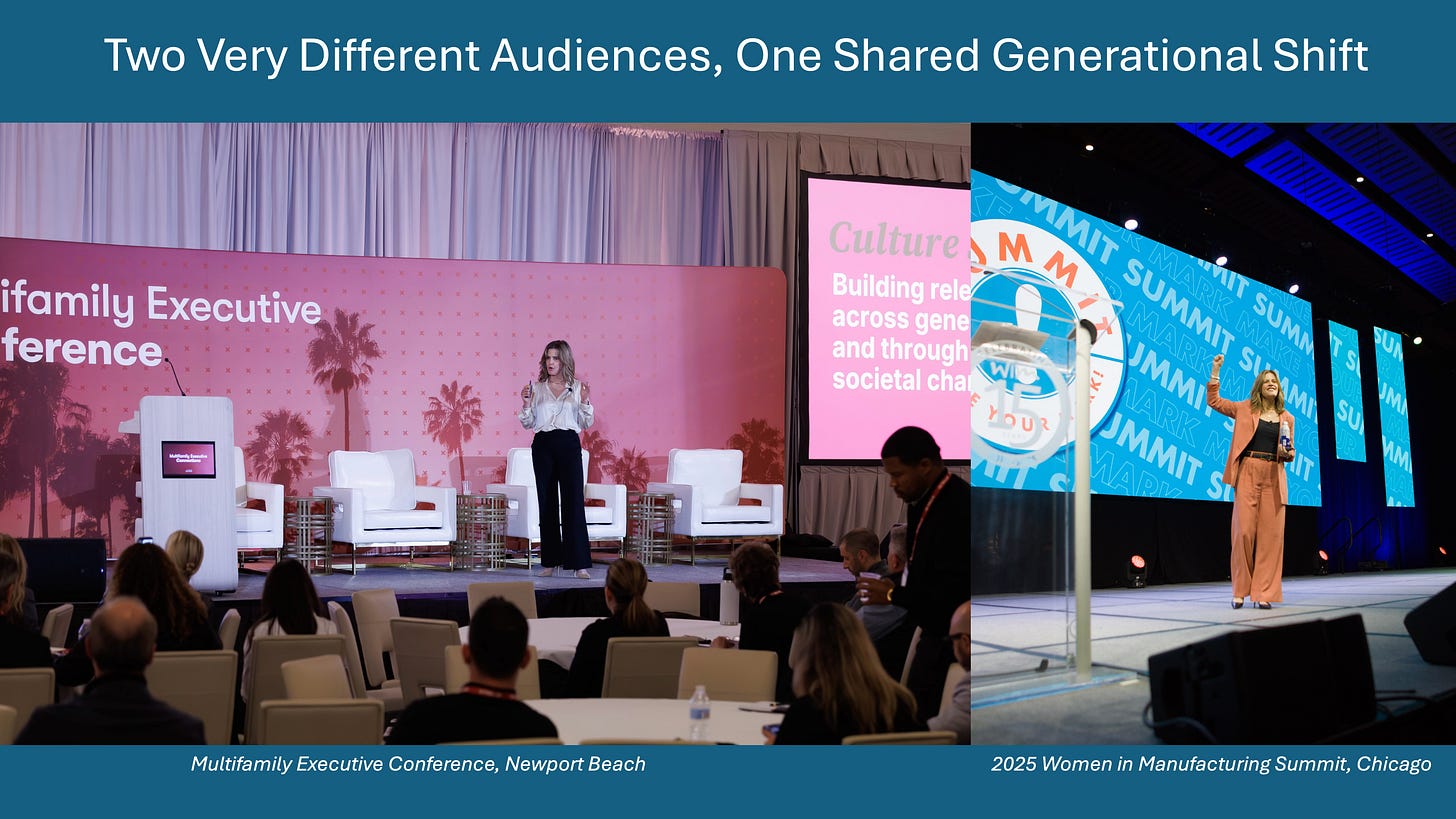
That’s what brought me to two conference stages in the past month. First was the Women in Manufacturing Summit 2025 in Chicago: 3,000+ leaders navigating AI disruption, tariffs, and five generations working side by side. Next up was the Multifamily Executive Conference (MFE Magazine) in Newport Beach: senior executives focused on winning Gen Z homebuyers (now 18-28) who are deciding whether to rent or buy in the hardest housing market in decades.
Different industries. Different priorities. Here is where they intersect
It Starts with Your Workforce
Delivering the differentiated customer experience Gen Z expects requires an engaged workforce that is fully in synch with the changing needs and expectations of the customer. These employees must be empowered to deliver in an elevated way that brings value on top of what the technology and systems can provide. And they need the ability to continuously innovate to meet consumers’ dynamic and changing expectations. All other generations will come to appreciate this elevated experience as well.
But there’s more. Your customers (often led by Gen Z) are assessing your business directly and indirectly based on the contentment of your employees. Indirectly they feel it in their interactions. Happy employees who feel valued treat customers better. Period. Directly, they are actively assessing your business practices as your business becomes a glass box and your workforce publicly shares how you treat them. Your Glassdoor rating already matters as much to Gen Z as your product reviews. Maybe more.
Are you building a company Gen Z wants to work for, or one they’re actively warning each other to avoid?
What This Looks Like in Practice
Years ago, my now 22-year-old Gen Z daughter urged (or guilted) me into using Lyft instead of Uber, explaining that Lyft was known for treating its employees better, with better benefits, better pay, and better policies. Right or wrong, those were the facts as she understood them, and they mattered to her and I felt compelled to go along.
Fast forward several years. On a recent trip, I told her I had compared the cost of Lyft and Uber and found Uber to be significantly cheaper. I suggested she consider that when choosing a ride from LGA into NYC. She checked and confirmed I was right. Like many in her generation, she’s financially pragmatic, so I knew the price difference would matter to her, even if I was the one paying.
So what did she do? She took public transit.
She could not justify paying more for one option over the other. And she still could not bring herself to use the service she believed treated its workers unfairly. In the end, both companies lost her business. And here’s what should terrify you: she’s not an outlier. She’s the blueprint for an entire generation that normalized inconvenience over comprising of values. They’ll take the subway. They’ll go without. In general, they won’t compromise.
Here is another example from a Gen Z employee’s viewpoint. A 23-year-old Starbucks barista had been transferred to a different store when his original location shut down. In the transition, he and his favorite co-workers were separated and moved to different stores. He quickly realized he did not enjoy his job as much without them. Starbucks honored his request to transfer him to the store where his friends had been reassigned.
Despite the improvement, and even though he was now working with his friends again, he resigned from Starbucks shortly after the move and found another job. Why? Because he did not feel a connection with the customers at the new location. It was in a tourist-heavy area with more grab-and-go interactions and fewer personal conversations. His original store had been in a residential neighborhood with regulars who knew him by name, just as he knew them. This wasn’t about benefits or pay. This was about meaning. And Starbucks, with all its data and efficiency metrics, never saw it coming.
The real question isn’t whether AI will transform your business. It’s whether you’ll still have employees and customers who care when the transformation is complete.
The Bottom Line
Meaningful innovation isn’t only about new technology or clever marketing strategies. It’s about understanding the human side of change from all angles. Real progress happens when businesses align their goals with the values of employees and the customers they serve and when we blend technology, humanity, and vision to make life better for all of us.
The most innovative companies aren’t just shaping markets. They are shaping a future their employees and customers want to be part of. So go ahead, keep pouring millions into AI while treating your workforce as a line item to minimize. Just don’t be surprised when Gen Z chooses the company that got it backwards: the one that invested in humans first and used AI to make them better. That’s the company that wins.