Research, writing, and a closer look at what’s shifting.
Original research, published articles, and Cultural Undercurrents, my ongoing read on the human and cultural shifts shaping what comes next.
100+ practitioner reports
10 years of longitudinal Gen Z research, among the most cited in the field
3 decades of original research
Links to my Substack where I dig into the human truths and cultural shifts already redefining what comes next.
Cultural Undercurrents
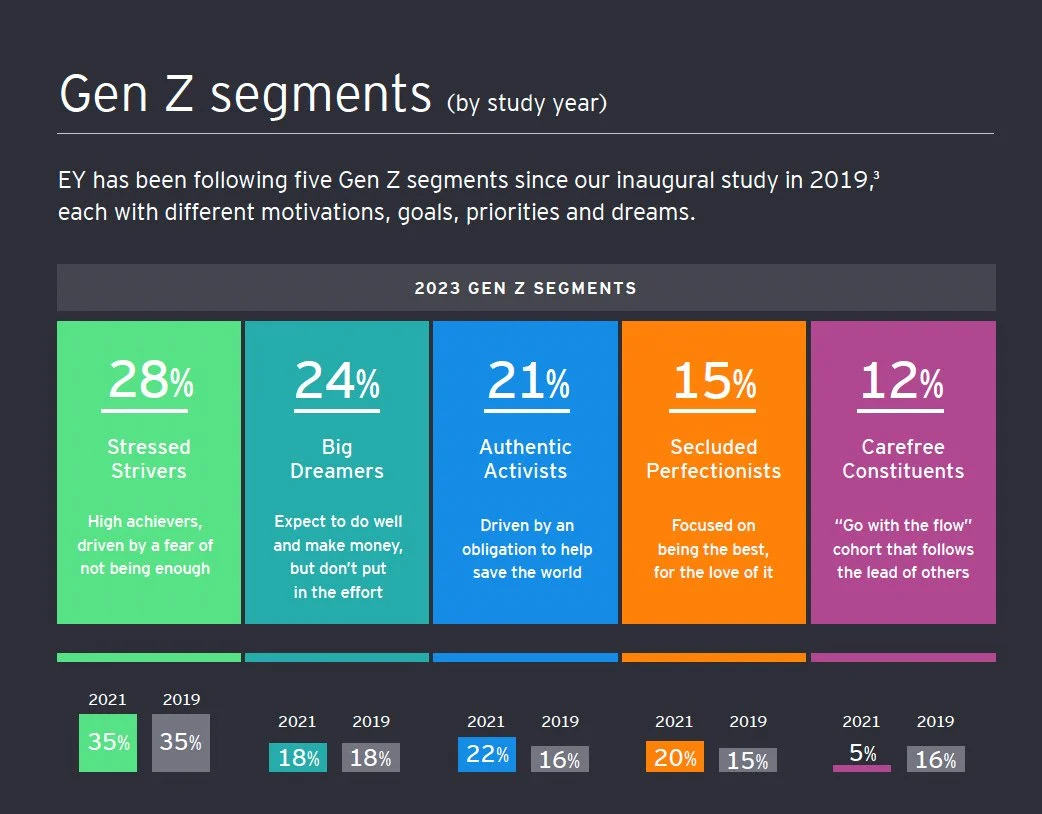
Gen Z is not one thing. That's the finding I keep coming back to. I led three studies on this at EY between 2019 and 2023, and each one turned up the same thing: five different groups inside the generation, with different goals, worries and money habits. One group is cautious with money. Another wants to be rich but isn't willing to work for it. A few care more about staying true to themselves than about fitting in.
As I wrote in the piece, when we flatten an entire generation into a handful of familiar headlines, we may grab clicks, but we lose the very differences that make the generation worth paying attention to. Leaders make better calls about their people, their customers and their strategy when they actually understand who they're dealing with.
Pew just released a major study on working parents. Most business leaders will read it as a workplace story. They should read it as a customer story. And an employee story. And a wake-up call.
Gen Z’s early skepticism of AI wasn’t about fear. It was a warning that people were tired of technology being sold as value before it actually created any, and that companies need to focus less on the AI itself and more on what it makes better for customers and employees.
This piece pushes past headlines portraying Gen Z as powerless in a difficult job market. Marcie examines the doom-scroll narratives, swipe-style job applications, and gaps between education and workplace expectations shaping the experience, then offers a more useful path forward grounded in agency, relationships, and honest feedback.
As companies race to adopt AI, they risk optimizing away the human connection Gen Z values most. Marcie explores why an engaged workforce remains a critical competitive advantage, and how businesses can use AI to strengthen, rather than diminish, the customer experience.
The Library
New research and articles land here as it's released.
Fertility is falling not because young people have changed their values, but because the world around them hasn’t kept up. Marcie’s research, along with that of the UN, helps explain why and what needs to shift.
Links to both in comments.
The First Global Generation: Adulthood Reimagined for a Changing World.
Marcie Merriman partnered with Zak Dychtwald, on behalf of EY, to lead one of the most ambitious global youth studies ever. Grounded in 10,000+ surveys, and decades of research in the field, through this study we offer a window into the values, mindsets, and life trajectories of today’s 18–34-year-olds in the U.S., China, India, Germany, Brazil, Japan, Saudi Arabia, South Korea, South Africa, and Sweden.
Co-authored by Marcie Merriman, EY Managing Director in partnership with Microsoft, this global study of more than 5,000 Gen Z respondents across 15 countries explores how young people use, understand and feel about AI. It identifies critical gaps in AI literacy and examines what businesses, educators and policymakers must do to prepare Gen Z for an AI-powered future.nging long-standing norms, this generation isn’t waiting for change. They’re driving it.
How is Gen Z driving shifts in how we all iive, work and play?
Led by Marcie Merriman, the 2024 EY Live Work Play Study draws on a survey of more than 3,000 Gen Z respondents across the United States. It explores how the generation is reshaping expectations around loyalty, transparency, financial security, work and consumption.
Part of EY's ongoing research series, this longitudinal study tracks how Gen Z thinks, feels, and behaves — and how that has changed over time. Led by Marcie Merriman, the research draws on a representative study of more than 1,500 Gen Z respondents across the United States. It explores the generation’s growing financial concerns, changing definitions of success, desire for authentic belonging and struggles with anxiety, revealing five distinct segments and what their evolving priorities mean for business.
Led by Marcie Merriman on behalf of EY, this research explores how Gen Z is redefining success around purpose, relationships, emotional well-being and financial stability. It examines what these changing priorities mean for the future of work and for organizations seeking to earn this generation’s trust.
Led and authored by Marcie Merriman as EY Managing Director, this international study draws on research with 5,000 members of Gen Z across China, Germany, Japan, Mexico and the United States. It identifies five distinct segments within the generation and explores how Gen Z’s attitudes toward authenticity, independence, trust and the future vary across countries. The findings offer an early view into how Gen Z will reshape expectations of businesses, employers and society.
The Archive
Reference points for how today's shifts began.