
Three years ago, I started raising a flag that few wanted to see.
The data showed Gen Z in the U.S. was less enthusiastic about AI than every other age group. The story became: “Gen Z fears AI.” “Gen Z worries about their jobs.” Clean headline. Easy narrative. Wrong conclusion.
What I was seeing was not fear. Gen Z was annoyed.
The Headlines Missed the Point
For Gen Z, technology is not exciting. It is not novel. It is infrastructure, falling into the same category as electricity and indoor plumbing. If a technology exists when you are born, it is not innovative, it is expected.
Gen Z was born into a world of smartphones, social platforms, and constant connectivity. The latest tech doesn’t “wow” this generation. Leading with tech as a consumer or employee value proposition may be worthy of an “Okay, boomer.”
In fact, the research I led for EY, studying young adults in ten countries, showed that 18-to-34-year-olds in countries with the most mature consumer-technology cultures are among the least excited about it. Enthusiasm runs highest in markets like India, South Africa, and China, where technology still feels like an accelerator, not a given. That is the context the headlines missed.
When AI arrived and older generations went electric. Gen Z didn’t say “wow.” They asked why?
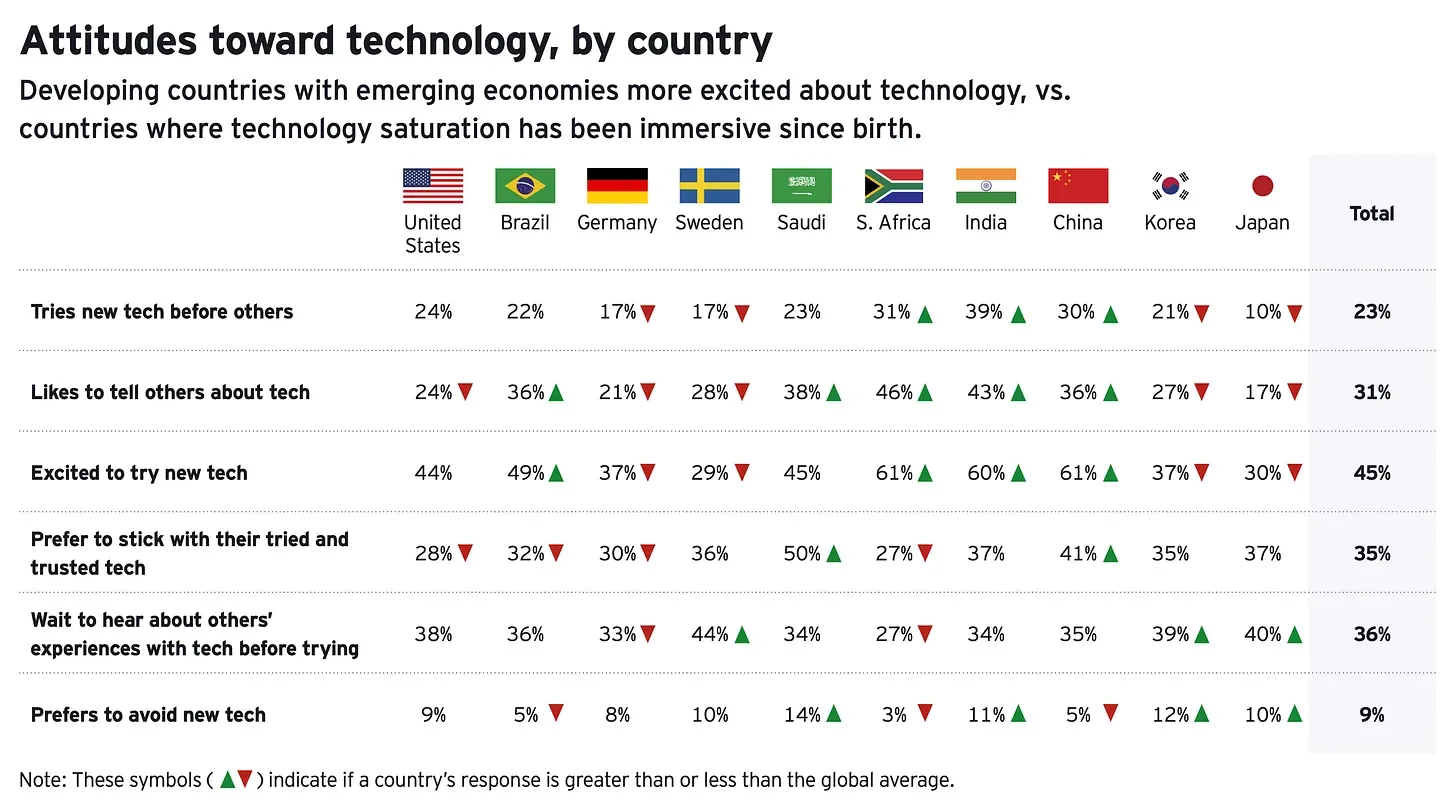
Source: EY Global Generation Report, 2025
Few Had an Answer
Gen X and older Millennials have a reflex we earned over decades of innovation: something new shows up, and we jump. The internet. BlackBerry. Social media. The metaverse. We do not always ask where we are going to land. We just go.
Gen Z in the U.S. does not work that way. They want to know what it is for, what problem it solves, and how it will make their lives better.
In the U.S., we largely did the opposite. AI was launched with excitement and the noise ran wild: promises of exponential business growth and shockingly large IPOs, alongside privacy concerns, existential risk, and job loss.
We handed a generation already living through economic chaos and global instability no clear picture of how any of this was supposed to improve their actual lives. The message they received was not “this will help you.” It was “this will improve business margins, replace work, and make the rich richer.” When people do not know the reason, they fill in the blanks. Under stress, the blanks fill dark.
The trust data shows how much framing matters. According to a 2025 Edelman poll, 88% of 18-to-34-year-olds in China say they trust AI. In the U.S., that number is 40%. That is not a gap. That is a canyon.
Whatever one thinks of China’s broader technology environment, the contrast in public trust suggests something important: people are more willing to accept AI when they can see its practical role in daily life. AI was framed there more as a partner than a threat, a tool working alongside people, and a way to make real tasks easier. The message was not “look at this technology.” It was “look what is now possible.” That difference matters.
But AI trust does not exist I isolation. The broader trust context reinforces this. My EY Global Generation Report found that 59% of U.S. young adults distrust most people, compared to just 23% in China. General distrust and AI distrust tend to travel together. That is the environment U.S. businesses are operating in, and in many ways, they helped create it.
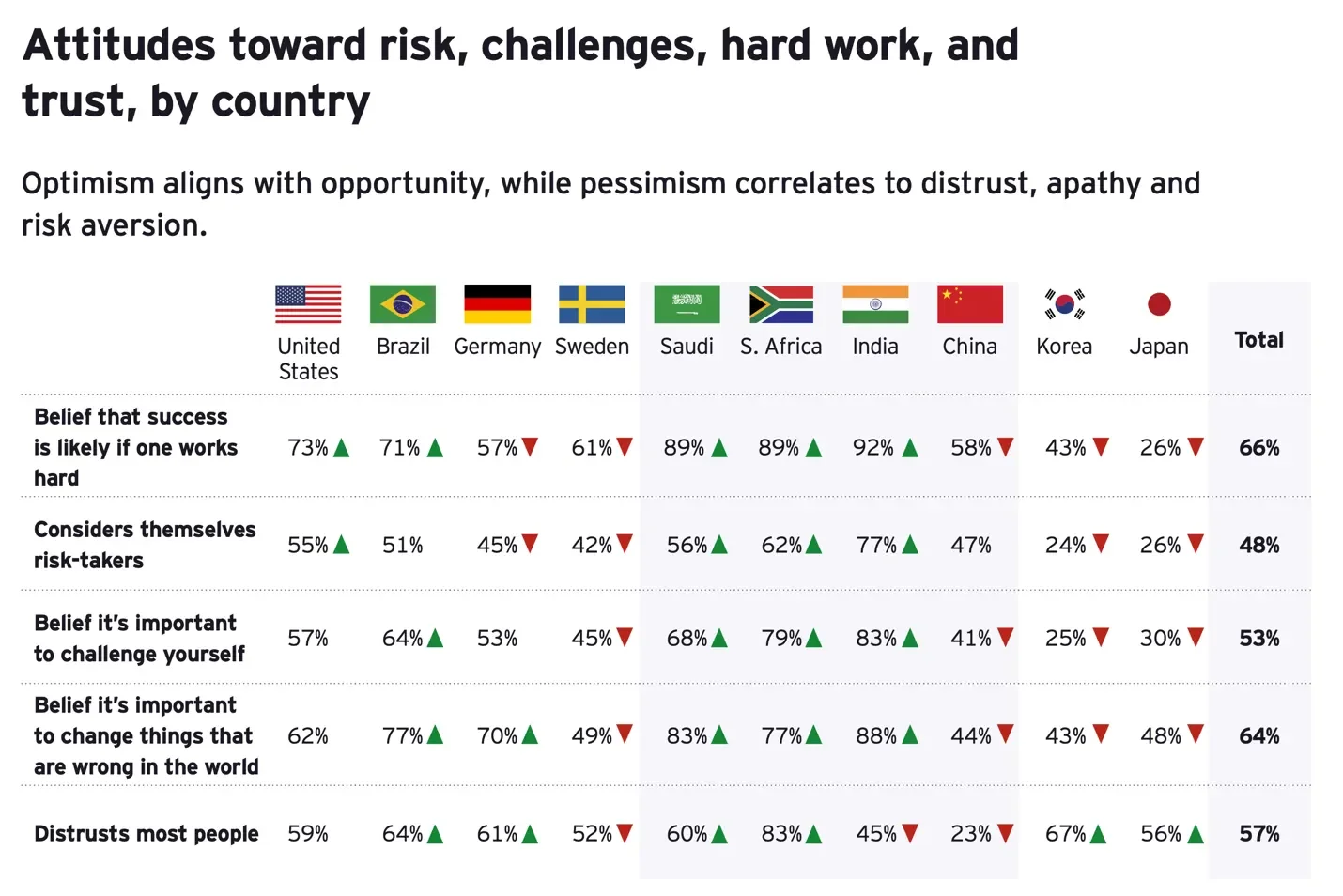
Source: EY Global Generational Report, 2025
Then Came the Sales Pitch
Just as the narrative was taking hold, businesses poured fuel on it. Not with bad intent. With bad judgment. The logic made sense on paper: AI is the hot thing, so put it front and center. Lead with it. Advertise it. Make AI the star of the show. That was the problem. Gen Z did not reject technology. They rejected the sales pitch.
Think about the last week of your own life. You opened a document and an AI offered to write it for you. You opened a design tool and AI started making suggestions. Useful sometimes, yes. But increasingly, AI is not removing friction, It is becoming the friction.
How often do you get the pop-up encouraging you to use AI, only to close the window just to get on with the task at hand? And how often do you try the AI only to discover the promise is bigger than the product?
That is not a feature. That is friction. It is the digital version of a server who pulls up a chair, sits down at your table, and pitches you on every item in the kitchen while your food gets cold. You came to eat. Nobody asked for the sales presentation.
The Free Pass Is Over
Here is where we are now. For years, companies led with AI because AI was the magic word. It signaled forward motion. It made companies sound modern. It made investor decks feel bigger. That window is closing.
AI is no longer a free credibility token. People have been hearing about it long enough to expect real results. The gap between the promise and the experience is getting harder to ignore. Even the word “bubble” has entered the mainstream conversation, not only among skeptics on the fringe, but among serious investors, journalists, and analysts asking a simple question: where are the results?
The numbers are hard to dismiss. According to Reuters, businesses invested $410 billion in AI in 2025 alone. A study of nearly 6,000 senior executives across four countries found that 90% report no measurable impact on productivity or employment after three years of AI investment.
And MIT found that 95% of generative AI pilots are failing to deliver their expected returns. Sam Altman, the CEO of OpenAI, has said publicly that investors as a whole are overexcited about AI. When the people building the technology are saying that out loud, something has shifted.
Gen Z was skeptical years ago, before the market started asking harder questions. They were the canary in the coalmine.
Now the question for every leader reading this is not whether you have an AI strategy. It is whether that strategy can produce real returns. And those returns will come from delivering something customers value, employees trust, and the business can measure.
If AI is not making something meaningfully better for the people it is supposed to serve, the ROI question has already been answered.
How to Move From Hype to Value
Winning back trust, with Gen Z and every generation, requires doing three things differently.
Stop selling the engine. The goal is the outcome, not the technology. If your system uses AI to make the experience faster, cleaner, more personal, or less frustrating, great. Deliver that experience. A hotel that uses AI to have your room ready before check-in does not need to put “AI-powered” on the key card. The experience says it all.
Name the pain before you name the tool. Before you introduce any AI capability to your staff or customers, start with what is broken. What is slow? What is hard? What makes people’s days worse? Then explain how things are going to get better. When leaders lead with the technology, people hear, “We found something that is going to disrupt how things work and suck up a lot of our time.” When they lead with the problem, people hear, “We understand what is hard, and we are trying to make it better.”
Prove it before you promote it. The market gave companies enormous goodwill for saying they were using AI. That credit is being spent. Real results come from closing the gap between the promise and the experience. A minimum viable product may be enough to test an idea internally, but it is no longer enough to meet the expectations companies have created externally. If you have been using AI for two or three years and cannot name one thing a customer or employee would describe as better without being prompted, that is your actual problem. Not your next rollout.
Gen Z Was Right to Ask Why
Gen Z’s skepticism toward AI did not come from fear. It came from a simple question too few bothered to answer: why? They held back while the rest of us were swept up in the wave. Now, three years later, the conversation is catching up to where they were all along.
They were not anti-AI. They were anti-hype, anti-friction, and anti-being told something mattered before anyone could explain why. A generation raised inside the interface can smell bad UX dressed up as innovation.
The companies that come through this will not be the ones saying AI the loudest. They will be the ones disciplined enough to make the technology disappear into a better experience.
The question is no longer whether your company uses AI. Everyone does or soon will. The question is whether anyone outside your company can feel the difference.